Embed Code for Taylor–Green Vortex CFD Simulation
Copy the embed code below to include this project on your website:
Taylor–green vortex cfd simulation
NoAI: This project, including models, simulations, images, and descriptions, may not be used within datasets, during the developmental process, or as inputs for generative AI tools.
About the Taylor–Green Vortex CFD Simulation Project
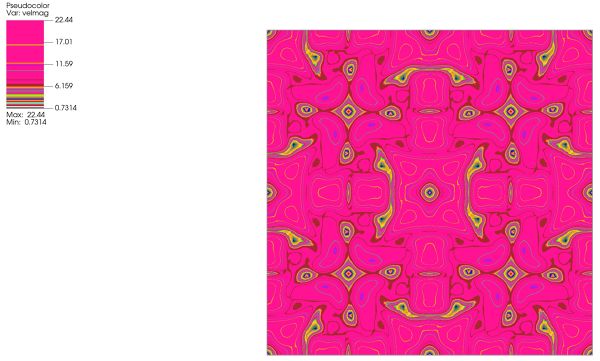
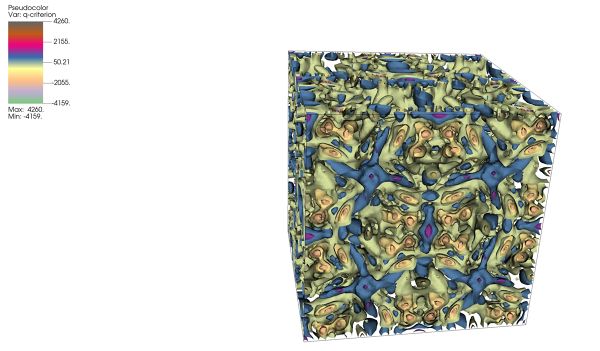
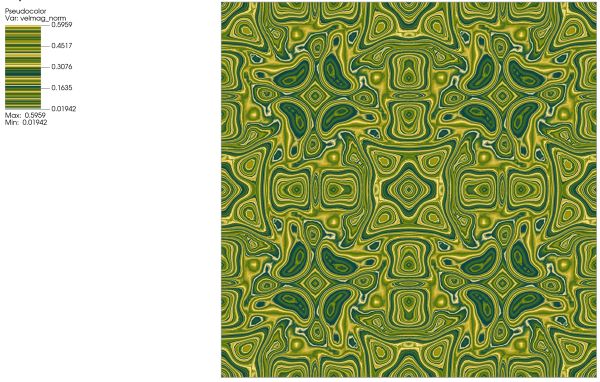
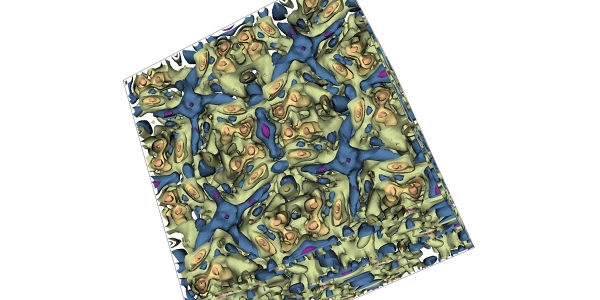
This simulation shows a 3D Taylor–Green vortex (TGV) computed with NumericalAI (https://numericalai.net/) in a triply periodic cubic domain. The flow is initialized as the classic Taylor–Green configuration and evolved at Reynolds number Re=1600 (with viscosity enabled), making it a standard benchmark for the transition from an ordered vortical field to broadband, decaying turbulence. The computation uses a compressible formulation with a low characteristic velocity () to approximate incompressible behavior, while high-order reconstruction (IGR, 5th order) helps preserve fine-scale structures and reduce numerical dissipation as the vortex breaks down. The first image visualizes the Q-criterion in 3D, highlighting coherent vortical structures through an isosurface rendering. The clustered, interconnected “worm-like” features indicate regions where rotation dominates over strain, capturing the emergence of small-scale vortices and the developing turbulent cascade. The second image shows a planar velocity magnitude contour (|𝘂|), revealing the characteristic symmetric pattern of high-speed regions and shear layers that intensify as the flow transitions. The third image presents the normalized velocity magnitude field, which emphasizes relative variations across the domain and makes the multi-scale organization of energetic structures more apparent, even where absolute speeds are smaller. Together, these views demonstrate the solver’s ability to resolve vortex stretching, breakdown, and the resulting complex turbulent topology in the TGV benchmark.

Related Projects


Sign up to join the conversation about Taylor–Green Vortex CFD Simulation
Post a comment! Share insights on Taylor–Green Vortex CFD Simulation, ask questions, and connect with other users. Whether you're curious about the 3D model, fluid simulation, or finite element analysis, your comments enrich the conversation.
No responses added yet.